
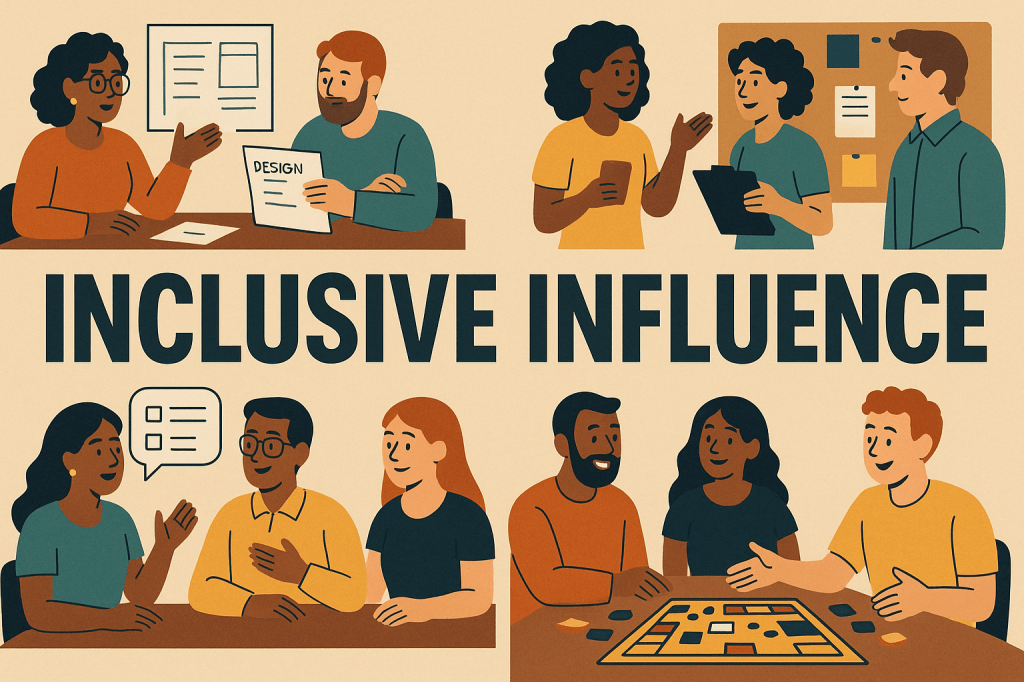
In any group — a team at work, a community project, or a circle of friends — influence is often misunderstood as control or persuasion. But real influence is more human than that. It’s about inclusion. About how you bring people along, especially when they think, speak, and show up differently.
Inclusive influence doesn’t rely on a single formula. It adapts. It balances. It listens.
Let’s explore what this looks like — from technical teams to game nights to large event planning — and how the approach must shift with the people and the moment.
Adapting Your Approach: One Size Doesn’t Fit All
People differ. So should your leadership style.
Inclusion means adjusting how you guide a group. Sometimes that means facilitating a structured discussion. Other times, it’s about knowing when to step back and let the group lead itself. The context — and the people — will tell you what’s needed, if you’re willing to listen.
Let’s walk through a few examples:
1. Code Design: Where Opinions Run Deep
In technical teams, discussions around code structure or system design can be passionate. Developers often have well-formed opinions based on experience, performance trade-offs, or architectural philosophies.
Influence here means:
- Respecting depth while keeping ego in check
- Creating structured opportunities for input
- Facilitating discussions that prioritize clarity over consensus
Here, inclusion means recognizing that every voice has technical merit — even when opinions clash.
2. Team Events: Where “Anything Works” Can Be Misleading
When planning a team activity — say a virtual trivia night or a lunch outing — you often hear:
“I’m good with whatever!”
But that nonchalance can be deceptive. It’s not that people don’t care — they just might not feel comfortable shaping the plan.
Influence in these cases means:
- Offering limited choices to lower decision friction
- Gently encouraging those who usually stay quiet
- Sharing the organizing role across the team over time
Inclusion here is about effort — helping people feel like they belong even when they don’t express strong preferences.
3. Expo Planning: Where Experience Meets New Energy
Planning a company expo or large-scale event often brings together a mix: some with deep experience, others with fresh perspectives.
This is where balancing becomes key:
- Let experienced members anchor timelines and logistics
- Let newer voices shape audience engagement or creative elements
- Use collaborative tools to give everyone a visible stake
Inclusion means co-creation — not handing down plans, but building them with people.
4. Game Night with Friends: Where Connection Runs Deeper
Now shift to a more personal setting — a group of friends playing a game.
It starts as a fun competition. But quickly, you notice someone’s not enjoying the overly competitive rules. Maybe someone else is new and doesn’t fully understand the game. The room feels a little off.
This is where true influence and inclusion show up: you change the rules.
Maybe you simplify the format, form mixed-experience teams, or adjust the win conditions to make it more fun than fierce. These changes may seem small — but they carry meaning. They say:
“You matter more than the mechanics.”
And when people feel seen like that — not just accommodated but valued — the connection goes deeper. The moment becomes less about the game and more about the people around it.
Inclusion, even in informal settings, often reveals our real values.
The Balancing Act: Inclusion Over Perfection
You won’t always please everyone. Not every idea can be implemented. And not every voice will want to take center stage.
But inclusion isn’t about getting it perfect — it’s about making the effort:
- Balancing clarity with flexibility
- Making time for feedback, even when the deadline is tight
- Showing how input shaped the final decision, even if the outcome differs
The real win? People feel safe to speak, contribute, and show up as themselves.
So, How Far Would You Go?
To truly include people, you need to go beyond default behavior. You need to:
- Ask, even when you think you know the answer
- Listen, especially when you don’t agree
- Adapt, even when it’s inconvenient
That’s where real influence lives. Not in pushing your idea forward — but in bringing people along in a way that builds trust, energy, and ownership.
Because influence that includes… connects.
 My Next Fire
Leave a comment